


A brass wall sconce can be quiet and theatrical at once: it doesn’t take up floor space, it finishes a wall like a piece of architecture, and it creates that “well-designed interior” atmosphere you feel before you notice any single object.
In this guide you’ll find 7 concrete ideas (for hallways, bedrooms and bathrooms,and beyond), a few simple rules to choose the right light, and the most common mistakes to avoid. If you’d like to start from the selection, explore our brass wall sconces made in Italy.
Why choose a brass wall sconce
Brass has a rare quality: it feels warm without being heavy, and luminous without shouting. In the Ghidini 1849 collections, brass is crafted and finished with great care, so the lamp becomes not only functional, but expressive.
A wall sconce is ideal when you want to:
- Create atmosphere: softer, lateral light that feels more intimate than a single ceiling point.
- Highlight a wall: paneling, wallpaper, niches, stone, artwork.
- Build layered lighting: combining wall + ceiling + table lighting.
For a gallery-like look, pair wall sconces with dedicated artwork lighting: our brass picture lights are designed for this purpose.
Before you start: 4 choices that change the result
Before going room by room, here are four variables that truly shape the final mood.
1) Light direction
- Up & down: architectural, elegant, perfect for hallways and living rooms.
- Diffused (glass/fabric shade): softer, ideal for visual comfort.
- Adjustable: best near beds, reading corners, and task zones.
2) Color temperature (plain English)
With brass, warm light usually wins: it enhances the metal, softens shadows, and makes a space feel welcoming.
3) Proportions
A sconce that’s too small disappears; too large can dominate. Think of it as a balancing point between wall height, nearby furniture, and function.
4) Finish and materials
Brass + glass feels brighter and cleaner; brass + fabric feels softer and more intimate.
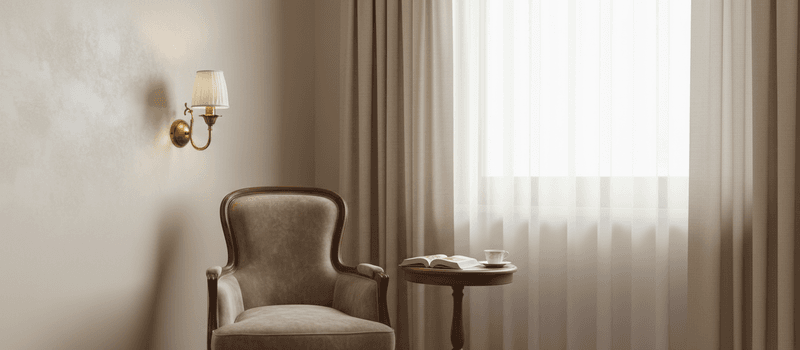
If you’re building a coherent style across rooms, our Art Deco and Art Nouveau brass lamps offer different expressions of the same material.
7 ideas (with real-world use cases) for brass wall sconces
1) Turn the hallway into a gallery: rhythm and depth
A hallway is a passage—but it can become an experience. A sequence of sconces creates visual rhythm and adds depth.
Practical tips:
- Keep the same style and finish along the path.
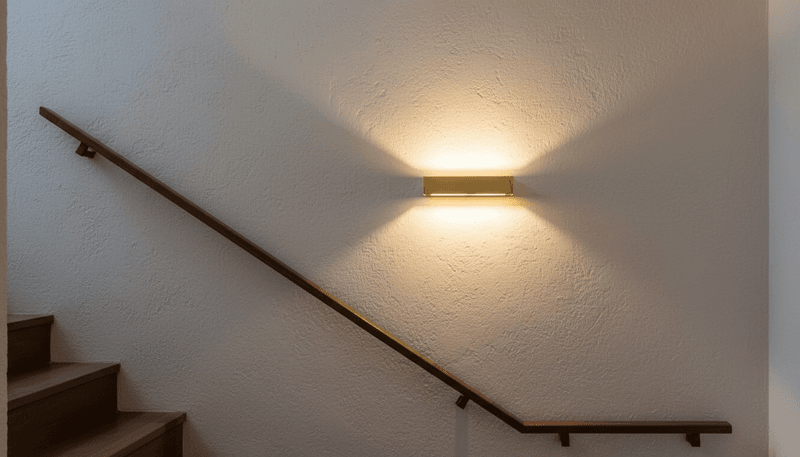
- For textured or character walls, consider up & down light to make the surface come alive.
Start here: brass wall sconces.
2) In the bedroom: two sconces instead of bedside lamps
Replacing bedside lamps with two wall sconces frees up the surface and gives the room a more tailored feel.
Do it well:
- Choose controlled, soft light (no glare).
- If you read in bed, consider an adjustable model.
To complete the lighting layers, a small accent piece can still be precious: explore brass table lamps.
3) In the bathroom: side lighting by the mirror looks better on the face
In bathrooms, it’s not about “more light”—it’s about the right light. Side lighting reduces harsh shadows compared to a single overhead source.
A helpful reference (to adapt to your project): This Old House suggests, as a general starting point for vanity sconces, roughly 60–70 inches from the floor (about 152–178 cm). See: How to Install a Wall Sconce.
For balanced ambient light, a ceiling fixture helps: explore brass ceiling lights.
4) On the staircase: safety, with a touch of theatre
A well-lit staircase is comfort and safety—but it can also be a controlled scenic gesture. Wall sconces create beautiful light gradients along steps and walls.
Tip: avoid glare when going up or down. Up & down light is often the most elegant choice here.
5) In the living room: accent light to define zones
In a living room, a sconce can define a conversation area, give depth to a wall, or support a reading corner.
Three easy ideas:
- A symmetrical pair flanking a sideboard.
- A sconce near an armchair (layered with a table lamp).
- Grazing light on a feature wall (stone, niche, wallpaper).
For a more contemporary vibe, explore Italian design lamps.
6) For artwork or a statement mirror: use dedicated picture lighting
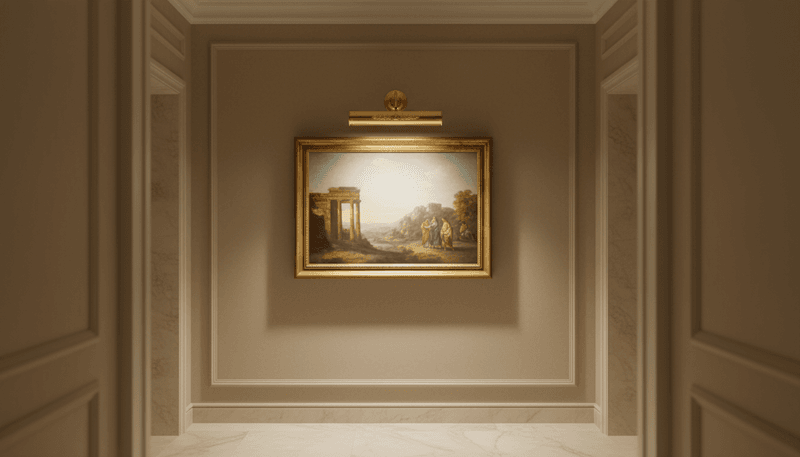
When the piece is the protagonist, the light must be precise. A picture light highlights without overpowering.
Start with picture lights or see a concrete example: floral picture wall lamp in brass with 30 cm shade.
7) In the kitchen (or dining area): a warm detail where you don’t expect it
A wall sconce works beautifully in kitchens when you want to soften the space—on a free wall, near a sideboard, or to add a luminous backdrop.
If you already have technical lighting, the sconce becomes the emotional layer.
Mistakes to avoid (and how to fix them)
1) Random lights, hoping for atmosphere
Fix: think in three layers (ambient, task, accent). A strong pairing is ceiling light + wall sconces, especially in hallways, bathrooms and bedrooms.
2) Glare: beautiful light should never feel harsh
Fix: prefer diffusers (glass/fabric) and positions that keep the source out of direct sightlines.
3) Wrong height (too high or too low)
There’s no single number for every room—but proportions matter. Use the reference above as a starting point, then refine based on mirror height, ceiling height and the user’s eye level.
4) Forgetting finish care
Ghidini 1849 brass finishes are protected by a transparent varnish: clean with a soft, dry, lint-free cloth only—no detergents, chemicals, or abrasives. For the full guide: cleaning brass.
Quick picking guide (60 seconds)
If you want a simple rule:
- Hallway: up & down or diffused, repeated with rhythm.
- Bedroom: diffused or adjustable, in pairs.
- Bathroom: side-by-mirror + ambient ceiling light.
- Living room: accent and atmosphere, layered with other sources.
When you’re ready to choose, our brass wall sconces made in Italy are a natural starting point—different lines, different interpretations, one common thread: brass finished with care since 1849.
FAQ: brass wall sconces
Are brass wall sconces suitable for small rooms?
Yes—especially compact models and diffused shades. In smaller rooms, wall lighting creates atmosphere without taking up surface space.
Should wall sconces be symmetrical?
Not always. Symmetry works beautifully by beds, mirrors and sideboards; asymmetry can be more contemporary and expressive in living rooms or stairwells.
How do I clean a brass wall sconce without damaging the finish?
Use only a soft, dry, lint-free cloth. Avoid detergents, alcohol, bleach and abrasives because the finish is protected by a transparent varnish.


